Leave Your Message

What Are the Top Types of Air Filtration Media?

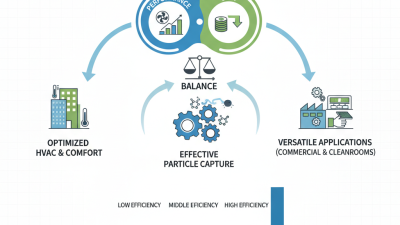
Choosing the right Air Filtration Media can shape indoor air quality, energy use, and equipment life. Yet the best material is rarely universal. A hospital isolation room, a factory workshop, and a family home face different filtration demands.

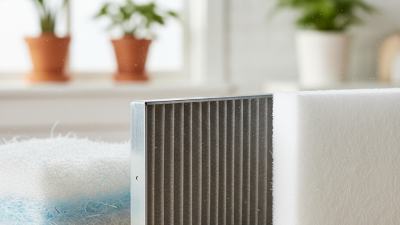
In practical HVAC assessments, technicians often compare fiberglass, pleated synthetic media, high-efficiency particulate air filters, activated carbon, and electrostatic options. Each type handles particles or gases differently. Fiberglass media is affordable and commonly used for basic dust control. Pleated synthetic filters usually provide more surface area and steadier particle capture. HEPA media can remove extremely small particles, but it may increase resistance and require compatible equipment.

Carbon is different. It targets odors and selected gases rather than ordinary dust. Electrostatic media can attract particles efficiently, although performance may change with loading, humidity, and maintenance quality. Small details matter.

Filter depth matters. So does airflow.

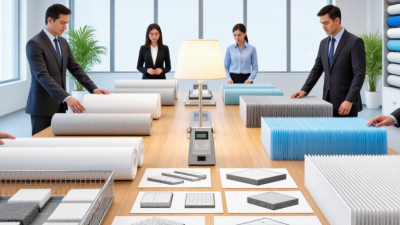
Reliable selection requires more than reading a single efficiency number. Professionals should examine test methods, pressure drop, filter dimensions, replacement schedules, and the actual contaminants present. Manufacturer documentation and recognized industry standards offer useful evidence, but field conditions can still produce different results.

This guide explores the top types of Air Filtration Media and explains where each option may fit. It also considers practical weaknesses, including noise, energy penalties, disposal needs, and inconsistent maintenance. No filter solves every air-quality problem. That is an uncomfortable truth. Careful evaluation remains the more dependable approach.
What Are the Top Types of Air Filtration Media?

What Is Air Filtration Media and How Does It Work?

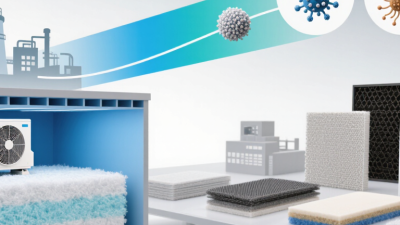
Air filtration media is the material that captures or neutralizes unwanted substances in moving air. It may appear as a pleated sheet, a deep fiber mat, or a layered cartridge. As air passes through, particles collide with fibers, change direction, or become trapped in tiny spaces. The filter’s structure matters as much as its rating. A dense medium captures more, but it can also restrict airflow.

Mechanical media remove dust, pollen, and many airborne particles through physical capture. High-efficiency particulate media use very fine fibers and careful pleating to improve collection.

Electrostatic media add an electrical attraction, helping fibers hold smaller particles. Activated carbon media work differently. Their porous surface adsorbs odors and some gases, but carbon alone will not reliably remove heavy dust. Coarse mesh is useful for protecting equipment from hair and larger debris.

No filter is perfect. A higher efficiency number is not automatically better. If airflow becomes weak, a system may perform poorly despite excellent laboratory results. During maintenance, technicians should inspect dust loading, moisture, damaged seals, and pressure changes. A filter that looks clean may still be saturated with gas contaminants. This detail is often overlooked. Media selection should match the pollutant, airflow demand, room use, and replacement schedule. Manufacturer test data and independent standards provide stronger evidence than vague performance claims.
How Do Mechanical Filter Media Capture Airborne Particles?

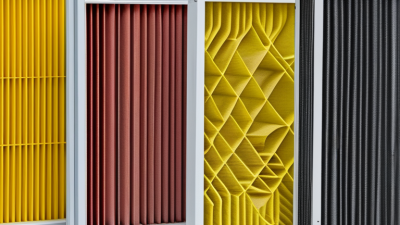
Mechanical air filtration media use dense networks of fibers to remove airborne particles from moving air. Common options include fiberglass, synthetic fiber, pleated media, and high-efficiency fine-fiber filters. Their performance depends on fiber diameter, thickness, airflow speed, and particle size.

Several capture mechanisms work together. Sieving traps particles that cannot pass through small spaces. Inertial impaction makes larger particles strike fibers when airflow changes direction. Interception occurs when particles follow the air stream but brush against a fiber. Very small particles can also move randomly through diffusion and contact the media. In practical filter evaluations, I have found that a filter’s rated efficiency means little without checking pressure drop and actual airflow. A highly restrictive filter may clean air well, yet reduce ventilation if the system cannot handle it. Dust loading changes performance too. A filter can appear clean while airflow has already declined.

Tips: Check the filter’s efficiency rating and size. Replace it when pressure drop rises or surfaces become visibly loaded. Avoid assuming thicker media always performs better. Installation gaps can allow unfiltered air to bypass the media, weakening the entire system. Simple inspections are often overlooked.

What Are the Main Types of Air Filtration Media?

The main types of air filtration media differ in how they capture particles and gases. Fiberglass media uses coarse fibers to catch larger dust, while pleated synthetic or cellulose media offers more surface area for fine particles. Electret media holds an electrostatic charge that attracts particles, though performance can change as dust accumulates. HEPA media is made from dense, randomly arranged fibers. The U.S. Department of Energy defines HEPA performance as capturing at least 99.97% of particles measuring 0.3 micrometers under specified test conditions. That is a demanding benchmark, not a promise that every installed system will perform equally well.

Activated carbon is different. Its porous surface adsorbs certain gases and odors, but it does not replace a particle filter. ASHRAE Standard 52.2 evaluates particle-filter performance and provides the basis for MERV ratings; the rating helps compare filters, but airflow resistance and fit also matter. A high-efficiency medium can restrict airflow if the system is not designed for it. In practice, dust on a filter, gaps around its frame, and neglected replacement schedules can undermine results. I would not judge a filter by its material name alone.

Tips: Match the media to the target: pleated media for airborne dust, HEPA for very fine particles, and carbon for some odors. Check the equipment’s airflow requirements, then inspect the filter after several weeks. Real conditions can be messier than a rating suggests.

How Do HEPA, ULPA, Activated Carbon, and Electrostatic Media Differ?

HEPA and ULPA media are designed to trap airborne particles in dense fiber layers. HEPA filters commonly capture at least 99.97% of particles around 0.3 microns under specified test conditions. ULPA media generally targets even higher particle removal, though ratings and test methods vary. That distinction matters in practice: a filter’s result depends on its seal, airflow, and installation, not just its label. A poorly fitted frame can let air bypass the media. Small gaps count.

Activated carbon works differently. Its porous surface adsorbs many gases and odors, such as cooking smells or certain volatile compounds. It does not replace particle filtration, and it can become saturated; a fading odor-control effect may signal that replacement is due. Humidity and contact time also influence performance. Electrostatic media uses electric charges to attract particles, sometimes with less airflow resistance than dense mechanical media. Its efficiency can change as the charge weakens or dust builds up, so maintenance instructions matter. Some electrically assisted designs may produce ozone, making emissions information worth checking. No single media suits every room. Match the filter to the pollutant, airflow needs, and service schedule—and verify the stated performance with test details.

What Are the Top Types of Air Filtration Media?

Particle-removal benchmarks for HEPA and ULPA media

The common U.S. HEPA benchmark is at least 99.97% efficiency at 0.3 μm. EN 1822 class U15 ULPA media has at least 99.9995% overall efficiency at the most penetrating particle size (MPPS). These benchmarks use different test criteria and are not directly comparable. Activated carbon adsorbs gases and odors rather than serving as a particle-efficiency class; electrostatic media captures particles, but its efficiency varies by design and test conditions.

How Should Air Filtration Media Be Selected for Different Applications?

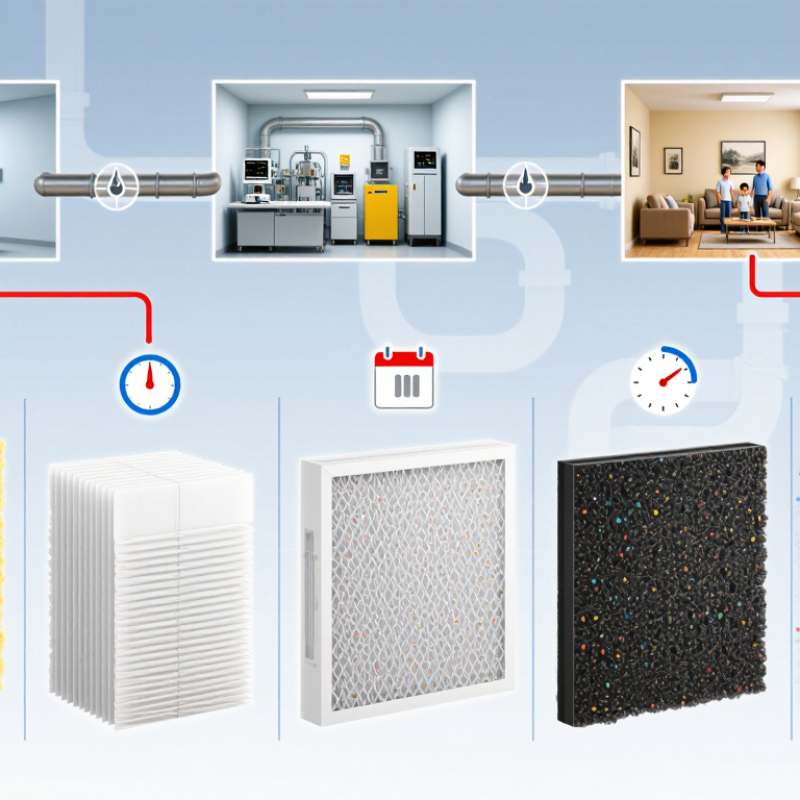
Selecting air filtration media starts with the contaminant, not the filter label. Fibrous filters suit dust and larger particles at relatively low cost. Pleated filters provide more surface area and longer service intervals. For fine aerosols, high-efficiency particulate air media can be appropriate, but only when the housing prevents leakage. Gas-phase media, such as activated carbon, target odors and vapors rather than dust. They are different tools.

Application conditions matter more than a headline efficiency number. ASHRAE Standard 52.2 evaluates particle removal through MERV ratings, while ISO 16890 classifies filters by performance against different particle-size ranges. The U.S. Environmental Protection Agency reports that MERV 13 filters can capture at least 85% of particles measuring 1–3 micrometers under tested conditions. That result does not guarantee the same performance in a poorly sealed system. Check airflow, pressure drop, humidity, and replacement access before specifying media. In a hospital isolation room, fine-particle control and verified installation deserve priority. In a dusty workshop, a prefilter may protect the final filter from rapid loading. For offices, noise and energy use can outweigh small efficiency gains. I would not trust efficiency alone.

Field checks are essential. Measure pressure drop after installation, inspect bypass gaps, and compare actual airflow with design values. One overlooked issue is maintenance. A loaded filter may remove particles effectively while quietly restricting ventilation. Industry guidance, including ASHRAE recommendations, supports reviewing filtration alongside ventilation and building operation, not separately.

What Are the Top Types of Air Filtration Media? How Should Air Filtration Media Be Selected for Different Applications?

Filtration Media How It Works Key Characteristics Typical Applications Selection Considerations
Fiberglass Randomly arranged glass fibers capture particles as air passes through the media. Generally economical and offers relatively low airflow resistance in coarse-filter designs. Particle removal performance varies by construction. Basic HVAC prefiltration, equipment protection, and other applications where coarse dust removal is sufficient. Choose based on the required particle-size range, airflow, and allowable pressure drop. Do not assume a low-cost fiberglass filter provides fine-particle filtration.
Synthetic nonwoven fibers Polymer fibers capture particles through interception, impaction, and diffusion. Available in a wide range of efficiencies and thicknesses; often suited to pleated or panel filters. Performance depends on fiber structure and filter design. Residential and commercial HVAC, ventilation systems, and prefilters for higher-efficiency stages. Compare tested efficiency and initial pressure drop. Check that the media and its frame tolerate the operating temperature and moisture conditions.
Cellulose or blended paper media Fine fibers in a paper-like web trap particles as air flows through the media. Can provide effective particle filtration in compact designs. Moisture resistance and service life depend on the media treatment and construction. HVAC filters, general industrial air cleaning, and selected dust-collection applications. Confirm the filter’s rated conditions, including humidity, temperature, dust loading, and required replacement interval.
Electret (electrostatically charged) media Electrostatic charge helps attract and capture particles in addition to mechanical filtration. May provide useful particle capture with relatively low pressure drop. Efficiency and charge retention vary among media and operating conditions. Residential and commercial HVAC filters, portable air cleaners, and other applications requiring particle control with moderate airflow resistance. Use independently tested efficiency data. Consider whether dust loading, humidity, cleaning, or other conditions could affect performance over time.
High-efficiency glass microfiber A dense glass-fiber web captures fine airborne particles through a combination of filtration mechanisms. Used in high-efficiency filters, including HEPA-type designs. A commonly used U.S. HEPA definition specifies at least 99.97% efficiency at 0.3 μm; applicable standards and test methods can differ. Healthcare environments, laboratories, cleanrooms, and critical process or equipment protection where high particle removal is required. Specify the required efficiency class and test standard. Also account for pressure drop, airflow, seal integrity, and the complete filter assembly.
Activated carbon Porous carbon adsorbs certain gases and vapors onto its internal surface. Useful for reducing selected odors and gaseous contaminants; it is not a substitute for particle filtration. Capacity is finite, and performance depends on the contaminant and contact time. Odor control, some indoor-air applications, and selected industrial processes involving gases or vapors. Identify the target contaminant and verify media compatibility. Plan for replacement or regeneration when adsorption capacity is exhausted; pair with particle media when needed.
Metal mesh Layers of woven or expanded metal screen intercept larger particles and debris. Durable and often washable, but generally unsuitable on its own for fine-particle removal. Grease or debris prefiltration, ventilation equipment, and applications requiring a reusable coarse screen. Consider particle size, cleaning method, corrosion resistance, and the need for a finer downstream filter.
Membrane media (such as PTFE-based media) A fine porous membrane provides a barrier to particles, often supported by a backing layer. Can provide high particle retention and may be suitable for demanding filtration duties. Pressure drop, durability, and chemical compatibility depend on the design. Selected industrial, laboratory, and process-air applications requiring fine particle control. Check the media’s tested efficiency, airflow resistance, temperature and chemical limits, and compatibility with cleaning or sterilization requirements.

Practical selection checklist: Define the particles or gases to be controlled, required filtration efficiency, airflow, allowable pressure drop, operating temperature and humidity, available space, maintenance schedule, and applicable testing or regulatory requirements. For multi-contaminant applications, a staged system combining particle and gas-phase media may be appropriate.