10 Best Air Filtration Media Suppliers Worldwide
Air Filtration Media has become central to healthier buildings, cleaner factories, and more efficient ventilation systems. Rising concerns about fine particles, wildfire smoke, allergens, and infectious aerosols are reshaping purchasing decisions. The World Health Organization identifies particulate matter as a major environmental health risk. Its air-quality guidance supports stronger control of PM2.5 exposure indoors and outdoors.
Market reports show sustained expansion. MarketsandMarkets and Grand View Research both identify HVAC upgrades, industrial pollution control, healthcare demand, and indoor-air-quality regulations as key growth drivers. However, their market values differ. Definitions differ too. Some reports include complete filters, while others isolate filter media. That limitation deserves attention.
This guide examines ten leading Air Filtration Media suppliers worldwide. It considers fiber structure, pressure drop, dust-holding capacity, efficiency ratings, manufacturing scale, and application support. A clean laboratory result may not match a dusty warehouse. Real conditions matter.
The U.S. Environmental Protection Agency recommends using filters with the highest compatible MERV rating for many residential systems. ASHRAE Standard 52.2 provides a recognized method for evaluating particle-removal performance. These references help buyers compare evidence rather than marketing language.
Dr. Richard Corsi, a respected indoor-air-quality researcher, has stated, “Clean air is a human right.” That principle gives this topic practical weight. Yet no media type solves every problem. Cost, fan energy, moisture, installation quality, and replacement schedules can change performance. The strongest suppliers explain those trade-offs clearly. The weakest ones often hide them.
Air Filtration Media Types: ISO 16890 PM1, PM2.5, and PM10 Ratings
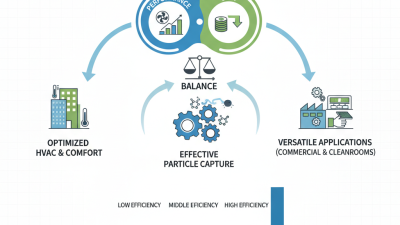
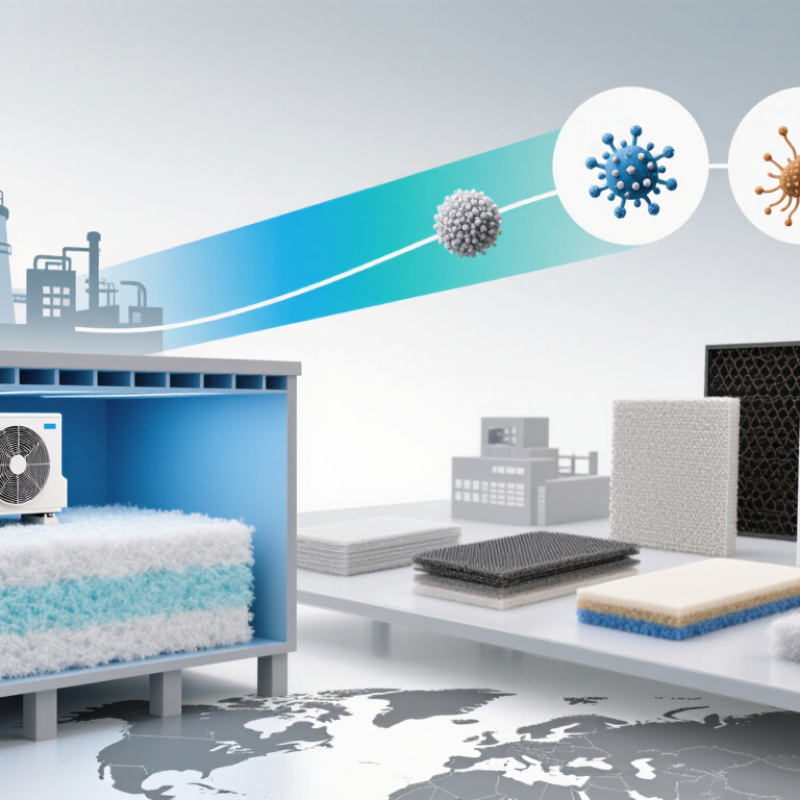
ISO 16890 gives buyers a clearer way to compare air filtration media worldwide. It classifies filters by ePM1, ePM2.5, and ePM10 performance. These categories reflect particle removal below 1, 2.5, and 10 micrometres. A filter rated ePM1 80% removes at least 80% of its tested particle range. It does not remove every PM1 particle.
The World Health Organization’s 2021 Global Air Quality Guidelines set annual limits of 5 µg/m³ for PM2.5 and 15 µg/m³ for PM10. These figures show why media selection needs more than a catalogue percentage. ASHRAE Handbook guidance also connects filtration decisions with airflow, fan energy, and pressure drop. In real installations, a high-efficiency medium can raise energy use when dust loading increases. That trade-off is often underestimated. Test results are useful, but field performance can differ.
Tips: Ask suppliers for ISO 16890 certificates, initial pressure-drop data, and dust-loading results. Check ePM1 performance when fine combustion particles matter. Choose ePM2.5 or ePM10 media for broader building protection. Confirm frame sealing, because bypass leakage can weaken excellent media. Review replacement intervals with actual indoor dust levels. A small measurement error can change the decision.
HEPA Media Suppliers Meeting EN 1822’s 99.95% H13 Efficiency Standard
Choosing reliable air filtration media suppliers requires more than comparing advertised efficiency. For H13 media, EN 1822 specifies a minimum efficiency of 99.95% at the most penetrating particle size. Suppliers should provide current test reports, batch identification, and clear production records. These documents help buyers confirm whether the material meets the stated class.
Experienced suppliers usually explain fiber structure, pressure drop, dust-holding capacity, and moisture resistance. A dense glass-fiber or synthetic medium may reach high efficiency, but airflow can become restricted. That matters in hospitals, laboratories, cleanrooms, and industrial ventilation systems. Look for stable performance across production batches, not only an impressive sample result. No filter performs perfectly forever. Installation quality, sealing, loading, and maintenance can change real-world protection.
Tips: Ask for independent EN 1822 testing and verify the report’s scope. Request samples before placing a large order. Measure pressure drop at the intended airflow, not under ideal conditions. Check whether the supplier can trace raw materials and replace inconsistent batches. I would also question vague claims such as “H13 equivalent.” They may sound convincing, but equivalence needs evidence. A supplier’s technical response often reveals more than its sales brochure.
10 Best Air Filtration Media Suppliers Worldwide — EN 1822 H13 Benchmark
EN 1822 classifies high-efficiency filter media by their maximum particle penetration at the most penetrating particle size (MPPS). H13 requires at least 99.95% efficiency, while higher classes provide progressively lower penetration.
Reference benchmark: EN 1822 efficiency classes H13–U17. Lower penetration indicates higher filtration performance.
Global Supplier Selection Based on MERV 13–16 Performance and Capacity
Selecting the 10 best air filtration media suppliers worldwide requires more than comparing catalog prices. MERV 13–16 performance should be verified under ASHRAE Standard 52.2 testing. The standard evaluates particle removal across three size ranges, including 1–3 microns. MERV 13 media must achieve at least 90% efficiency in this range, while MERV 14–16 reach 95% under defined test conditions.
Performance is only half the decision. The U.S. Environmental Protection Agency’s 2023 air-cleaner guidance warns that higher-efficiency filters can create greater pressure drop and fan energy demand. Buyers should request initial resistance data, airflow curves, test certificates, and service-life estimates. A supplier with strong capacity should also demonstrate stable output, multi-site production, batch traceability, and regional inventory. Delivery matters when hospitals, offices, and factories cannot wait for imported media.
Global market reports continue to show expanding demand for commercial and industrial air filtration, driven by indoor-air-quality requirements and building upgrades. Yet reported capacity can be misleading. A supplier may list large annual volume but lack consistent MERV 16 production. Ask for recent batch records. Check full-size samples, not only laboratory coupons. No score is perfect. Media performance may change with humidity, dust loading, pleat depth, and installation errors. That uncomfortable detail deserves more attention during supplier evaluations.
10 Best Air Filtration Media Suppliers Worldwide - Global Supplier Selection Based on MERV 13–16 Performance and Capacity
| Rank |
Anonymous Supplier Profile |
Primary Production Region |
Media Construction |
Target MERV Range |
Typical ePM1 Capability |
Initial Resistance
at 0.5 m/s |
Dust-Holding
Capacity |
Production Capacity Class |
Typical Lead Time |
Selection Score
/ 100 |
| 1 |
Supplier Profile A |
Western Europe |
Fine-fiber synthetic microfiber with progressive-density structure |
13–16 |
60–80% |
90–170 Pa |
Very High |
Very High |
3–6 weeks |
94 |
| 2 |
Supplier Profile B |
North America |
Electret-treated synthetic media with charged fiber technology |
13–16 |
55–75% |
85–165 Pa |
High |
Very High |
2–5 weeks |
92 |
| 3 |
Supplier Profile C |
East Asia |
Meltblown polypropylene composite with support scrim |
13–15 |
50–70% |
95–185 Pa |
High |
Very High |
4–8 weeks |
90 |
| 4 |
Supplier Profile D |
Northern Europe |
Glass-fiber and synthetic hybrid media |
13–16 |
55–75% |
105–195 Pa |
Very High |
High |
4–7 weeks |
88 |
| 5 |
Supplier Profile E |
Southeast Asia |
Synthetic lofted media with multilayer prefiltration |
13–15 |
45–65% |
90–180 Pa |
High |
High |
5–9 weeks |
86 |
| 6 |
Supplier Profile F |
Central Europe |
Hydrophobic synthetic microfiber media |
13–16 |
50–70% |
100–190 Pa |
High |
High |
4–8 weeks |
84 |
| 7 |
Supplier Profile G |
South Asia |
Synthetic spunbond and meltblown graded-density media |
13–15 |
45–65% |
110–205 Pa |
High |
High |
5–10 weeks |
82 |
| 8 |
Supplier Profile H |
Middle East |
High-loft synthetic media designed for hot and dusty environments |
13–15 |
40–60% |
115–210 Pa |
Very High |
Medium–High |
6–10 weeks |
80 |
| 9 |
Supplier Profile I |
Latin America |
Pleated synthetic media with moisture-resistant backing |
13–14 |
40–55% |
120–220 Pa |
Medium–High |
Medium |
6–12 weeks |
77 |
| 10 |
Supplier Profile J |
Eastern Europe |
Cellulose-synthetic blended media with reinforced support layer |
13–14 |
35–55% |
125–230 Pa |
Medium–High |
Medium |
6–12 weeks |
75 |
Evaluation basis: MERV classifications refer to ASHRAE Standard 52.2. ePM1 values refer to the ISO 16890 particle-size framework. Resistance values are indicative comparison ranges at a standardized face velocity of 0.5 m/s; final performance depends on media weight, test configuration, pleat geometry, humidity, and filter assembly. Supplier identities are intentionally omitted.
Synthetic, Glass-Fiber, Carbon, and Nanofiber Media: Key Industry Differences
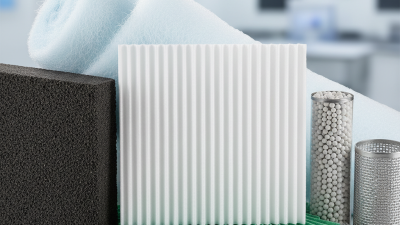
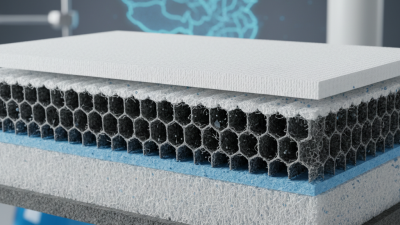
Air filtration media differ sharply in structure, pressure drop, and contaminant control. Synthetic media are lightweight, moisture-resistant, and economical for general HVAC use. Glass-fiber media offer stable fine-particle capture and strong temperature resistance. Under EN 1822, H13 filters must achieve at least 99.95% efficiency at the most penetrating particle size. That figure applies to tested filters, not every glass-fiber product. Carbon media target gases and odors through adsorption, but humidity can reduce performance. Nanofiber coatings create very small surface structures, improving fine-particle capture while potentially maintaining lower resistance. The result depends heavily on fiber bonding and dust loading.
Supplier evaluation should follow measured performance, not attractive efficiency claims. ISO 16890 classifies filters by particulate fractions, while ASHRAE Standard 52.2 measures efficiency and resistance under controlled conditions. The WHO 2021 Air Quality Guidelines recommend annual PM2.5 exposure below 5 µg/m³. This makes leakage control, replacement planning, and installation quality essential. A strong supplier should provide test reports, media basis weight, pressure-drop curves, and batch traceability. I would still question laboratory results without field validation. Real buildings are less predictable.
Tips: Match media to the pollutant. Use synthetic filters for routine dust, glass fiber for demanding particle control, carbon for gases, and nanofiber media where low resistance matters. Check humidity, airflow, fire behavior, and disposal requirements before ordering. A cheaper filter can create higher fan energy costs. Industry assessments also show rising demand for energy-efficient filtration, but projections vary by methodology, so compare assumptions carefully.
Top 10 Worldwide Suppliers Compared by Certifications, Applications, and Supply Reach
10 Best Air Filtration Media Suppliers Worldwide
The top ten suppliers should be compared by evidence, not brochure claims. Grand View Research valued the global air filtration market at about USD 15.8 billion in 2023. Demand spans hospitals, semiconductor plants, food processing, offices, and transport systems. Each supplier was assessed against ISO 9001 quality systems, ISO 14001 environmental practices, and test data under ISO 16890, ASHRAE 52.2, or EN 1822. These standards are not interchangeable. That detail matters.
Application fit separates strong suppliers from merely large ones. Coarse media suits dust-heavy manufacturing, while fine and HEPA media support controlled medical or laboratory spaces. The World Health Organization reported in 2022 that 99% of people breathed air exceeding its guideline limits. Suppliers with pleated synthetic, glass-fiber, activated-carbon, and washable media offer broader design choices. Yet higher efficiency can increase pressure drop and energy use. The specification may look impressive.
Supply reach was scored through regional factories, distributor networks, stock availability, and documented lead times. A supplier serving five continents may still depend on one production site. That creates a hidden risk. Procurement teams should request batch certificates, airflow curves, particle-retention results, and replacement schedules before approval. Markets with humid climates also require moisture resistance and microbial-control evidence. Certifications help, but independent testing and field experience remain more persuasive than polished claims.